
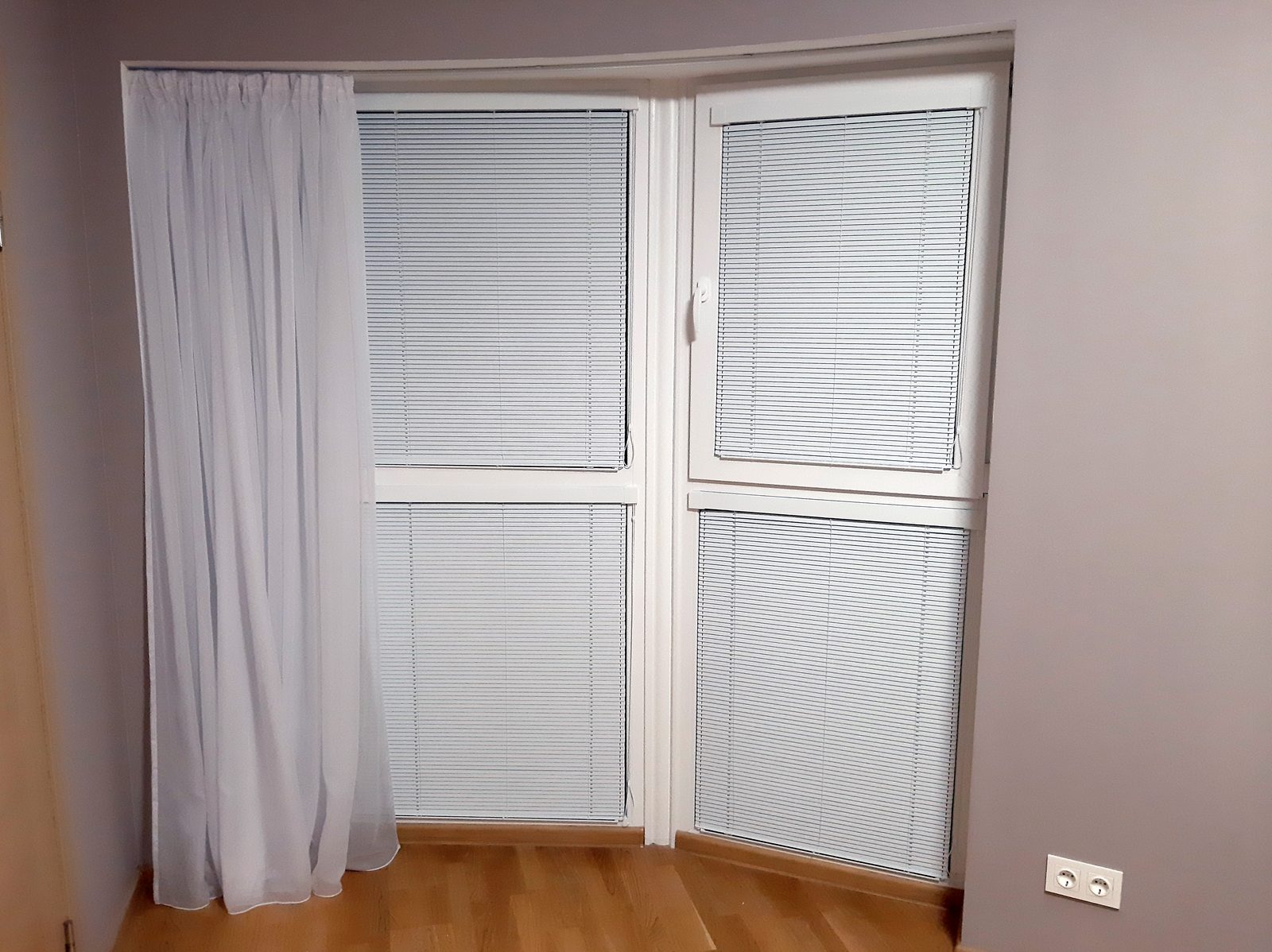
Why avoid drilling at all
A PVC window is a profile with several chambers, steel reinforcement inside and seals around the perimeter. A screw in the frame is not a disaster in itself, but it has three consequences: the hole stays there for good (when you change the blind you either hit the old holes or fill them), a badly placed screw can catch the reinforcement or the chamber that houses the hardware, and in a rented flat or a new build under the developer’s warranty it is simply not allowed. That is why manufacturers of systems for PVC windows have long supplied fixings that grip the sash without a single hole in the frame — and that is how we fit most sash-mounted blinds.
It is worth understanding that "without drilling" covers several different things. Some fixings never touch the frame with a screw at all, and then there is fixing into the glazing bead — the narrow removable strip that holds the glazing unit in place: a screw does go into it, but the frame stays intact, and a bead can be replaced for a few euros if you ever want to. Here is each option in turn.
Four ways of fixing to a PVC window
- Clamp-on (tension) brackets on the sash. A plastic or metal bracket hooks over the top edge of an opening sash and clamps on — it is held by the geometry of the profile. No drilling, no adhesive, no marks, and it comes off in a minute. This is how 16/25 mm venetian blinds are fitted (the type E bracket on the V13 system), along with Midi 25/28 roller and Day–Night blinds and Vegas pleated blinds. The drawback: it only works on opening sashes — on a fixed pane there is no edge to grip.
- Adhesive profile or adapter. The headbox or bracket is fixed on an adhesive mounting pad, either to the glazing bead or to the face of the sash. The Uni 19 cassette, for instance, comes in three versions: headbox screwed into the bead, headbox with a profile bonded to the bead, and headbox with an adapter bonded to the sash. The advantage: it also works on fixed panes, where a clamp-on bracket has nothing to grip. The drawback: it only holds on clean, degreased, warm PVC, and it dislikes heavy fabrics and direct sun on dark frames.
- Fixing into the glazing bead. Screws of 3–4 mm go into the glazing bead — the removable strip around the glass. Technically that is drilling, but not into the frame: it is the standard method for cassette and pleated blinds and the most rigid of the compact options. Cassette side channels are also fixed to the bead.
- Face fixing to the frame or wall. Brackets screwed into the frame, the jamb or the wall above the window. For everything that will not fit on a sash: large RT and Absolute roller blinds, verticals, Romans, 50 mm wooden blinds. Here there is no way round drilling — but it will carry any weight.
Household double-sided tape from the DIY shop and the adhesive mounting pads used by manufacturers are two different things. The first holds until the first hot day. The second is formulated for PVC and rated for the weight of the specific blind, but it needs the surface prepared: cleaned, degreased, pressed home and left unloaded for a while. We only bond where the manufacturer intends it — as with the Uni 19 headbox — and only with lightweight blinds.
Which blinds can be fitted without drilling
| Blind | No-drill method | Sizes on the sash | Does the window still open |
|---|---|---|---|
| Aluminium venetian 16/25 mm (V13) | type E bracket on the sash; side guidance — type L cord holders, no drilling | 16 mm: 20–200 cm, up to 250 cm high; 25 mm: up to 298 cm | yes, with guide cords it stays put when tilted |
| Isotra Hit 16/25 mm | side guidance on cords, brake mechanism | 30–200 cm, height up to 220 cm, up to 2.5 m² | yes, for tilt-and-turn sashes and roof windows |
| Roller Midi 25/28 | sash mounting, the fixing type is chosen during the survey | 30–170 cm, height up to 260 cm, up to 3 m² | yes, tilts freely |
| Day–Night Midi 25/28 | sash mounting; optional side guidance to keep the fabric against the glass | 30–170 cm, height up to 260 cm, up to 3 m² | yes, tilts freely |
| Cassette Uni 19 (incl. Day–Night) | headbox with a bonded profile or adapter; side channels on the glazing bead | 30–150 cm, height up to 220 cm, up to 2.4 m² | yes, the fabric runs in side channels |
| Pleated Vegas PV1/PV2 | clamp-on shoes and brackets (types C–F), fixing into the glazing bead | from 20 × 20 up to 150 × 150 or 120 × 220 cm | yes, including sloping and roof windows |
| Pleated Cosiflor VS | tensioned systems on wires | up to 150 × 150 or 120 × 220 cm; VS2-ML up to 200 × 220 cm | yes, at any angle |
| Roman Moderno | no-drill brackets on the sash | 35–300 cm, height up to 300 cm, up to 5 kg of fabric | depends on the width of the blind |
What cannot be done without drilling: wooden and bamboo blinds (too heavy), verticals (the headrail goes on the wall or ceiling), large RT 40/45 and Absolute roller blinds, and 35 and 50 mm aluminium. Those are face-fixed, and that is entirely normal: a 5–10 m² blind cannot hang from a clamp.
Glazing bead, handle and depth: what gets in the way
Three things about the window decide whether a blind will sit on the sash, and all three can only be judged in person.
- The glazing bead. Its width and the angle of its chamfer determine which headbox and which side channels will fit. On Uni cassettes the fabric width is calculated from the distance between the inner edges of the beads (XW − 1.2 cm) and the overall headbox size is XW + 3.0 cm; if the bead has a pronounced chamfer, the fabric is ordered narrower, to the width of the glass. Vegas pleated blinds come with holders for different bead sizes — that has to be measured, not guessed.
- The handle. A protruding window handle is a headbox’s worst enemy: the fabric or the cassette will foul it. The answer is a system with a smaller headbox (Uni 19, Midi 25/28), offsetting the blind, or mounting it on projection brackets.
- The depth to the glass. If the glazing unit is set shallow (a narrow bead), a cassette headbox will not fit between the bead and the face of the sash, which leaves the free-hanging systems. If the depth is generous, the blind can be tucked entirely within the sash.
Bracket or adhesive: a comparison
| Criterion | Clamp-on bracket | Adhesive profile | Screw into the glazing bead |
|---|---|---|---|
| Marks on the window | no | possible adhesive residue, removable with heat | holes in the bead, and the bead can be replaced |
| Fixed panes | no — an opening sash is required | yes | yes |
| Load | light and medium sash-mounted blinds | lightweight blinds | any of the compact systems |
| Dark frames, south-facing | no restrictions | take care: heat weakens the adhesive | no restrictions |
| Removal and relocation | in a minute, as often as you like | once, with a new adhesive pad | removal yes, relocation means new holes |
| Who fits it | DIY possible, a fitter is better | a fitter: surface preparation is critical | a fitter |
Keeping the window usable: sash and wire
When a blind sits on the sash, the window carries on opening and tilting — that is the whole point. When it tilts, though, the bottom edge of a free-hanging fabric swings away from the glass and starts to move about. That is why the compact systems offer side guidance: venetian blinds have cords threaded through the slats with holders on the lower bead (type L holders on V13 need no drilling; on Isotra Hit cord guidance is standard), Day–Night blinds have optional side guidance so the bottom bar stays against the glass, cassette blinds have rigid side channels, and tensioned pleated blinds have wires over the full height. A Midi roller blind without guidance will swing away from the glass when the window is tilted — if the window is often left on vent, choose a cassette or add side guidance.
Five mistakes that make a no-drill fixing come away
- Adhesive on dirty or cold PVC. The surface has to be degreased and pressed home at room temperature; on a balcony in winter the adhesive pad simply will not bond.
- A clamp-on bracket on the wrong sash. On a fixed pane a clamp has nothing to grip, and on a profile that is too thin — or too wide — the standard bracket will not seat properly, so a different type is needed.
- A heavy blind on a light fixing. The area limits for compact systems are not arbitrary: Midi — 3 m², Uni — 2.4 m². Anything larger goes on screws.
- Measuring "to the glass" instead of "between the beads". A cassette ordered to the visible glass will either not fit or leave gaps down the sides. Measure to the inner edges of the glazing beads — and on a chamfered bead, take the glass width as well.
- Forgetting the handle and the sill. The fabric fouls the handle, the bottom bar lands on the sill, and the window will no longer tilt. A survey with the sash opened settles all of this before the order goes in.
Survey and order
For sash-mounted blinds we do not accept sizes over the phone: our fitter comes with samples and bracket templates, measures the distance between the glazing beads at three points, checks the handle, the depth and the way the window opens, and tells you on the spot which fixing method suits that particular sash. On V13 venetians and Vegas pleated blinds the no-drill fixing is an option; for Midi roller and Day–Night blinds the fitter selects the version — and the calculators on the product pages price everything from the manufacturer’s price list. Manufacture takes 6–15 working days, the warranty is 2 years (4 years on Vegas pleated blinds); installation is quoted after the survey.
Frequently asked questions
Which blinds can be fitted to a PVC window without drilling?
Aluminium venetian blinds of 16/25 mm in the V13 system on type E brackets, Midi 25/28 roller and Day–Night blinds on the sash, Uni 19 cassette blinds with a bonded profile or adapter, Vegas pleated blinds on clamp-on shoes and brackets, tensioned Cosiflor VS pleated blinds, and Moderno Roman blinds on special brackets.
Will blinds stay up on sticky tape?
An adhesive mounting pad supplied by the manufacturer for the purpose (the bonded profile on the Uni 19 headbox, for example) will hold a lightweight blind on clean, degreased PVC. Household double-sided tape is not suitable for blinds. Heavy or large blinds go on brackets or screws only.
Will the window still open and tilt?
Yes, provided the blind is on the sash. To stop the fabric swinging away from the glass when the window tilts, the compact systems offer side guidance: cords on venetian blinds, side guidance on Day–Night, side channels on cassettes and wires on tensioned pleated blinds.
Does fixing into the glazing bead count as drilling the window?
Strictly speaking the screw goes into the glazing bead — the removable strip around the glazing unit — and not into the frame. The holes stay in the bead, which can be replaced if need be. This is the standard and most rigid method for cassette and pleated blinds.
Can anything be fitted without drilling to a fixed pane?
Clamp-on brackets, no: they need the edge of an opening sash. On a fixed pane the options are bonded profiles (Uni 19) or fixing into the glazing bead.
How much does a no-drill fixing cost?
For Midi 25/28 roller and Day–Night blinds the fitter selects the no-drill fixing during the survey. On V13 venetians and Vegas pleated blinds it is an option, and the calculators on the product pages price it from the manufacturer’s price list. Installation is quoted after the survey.