
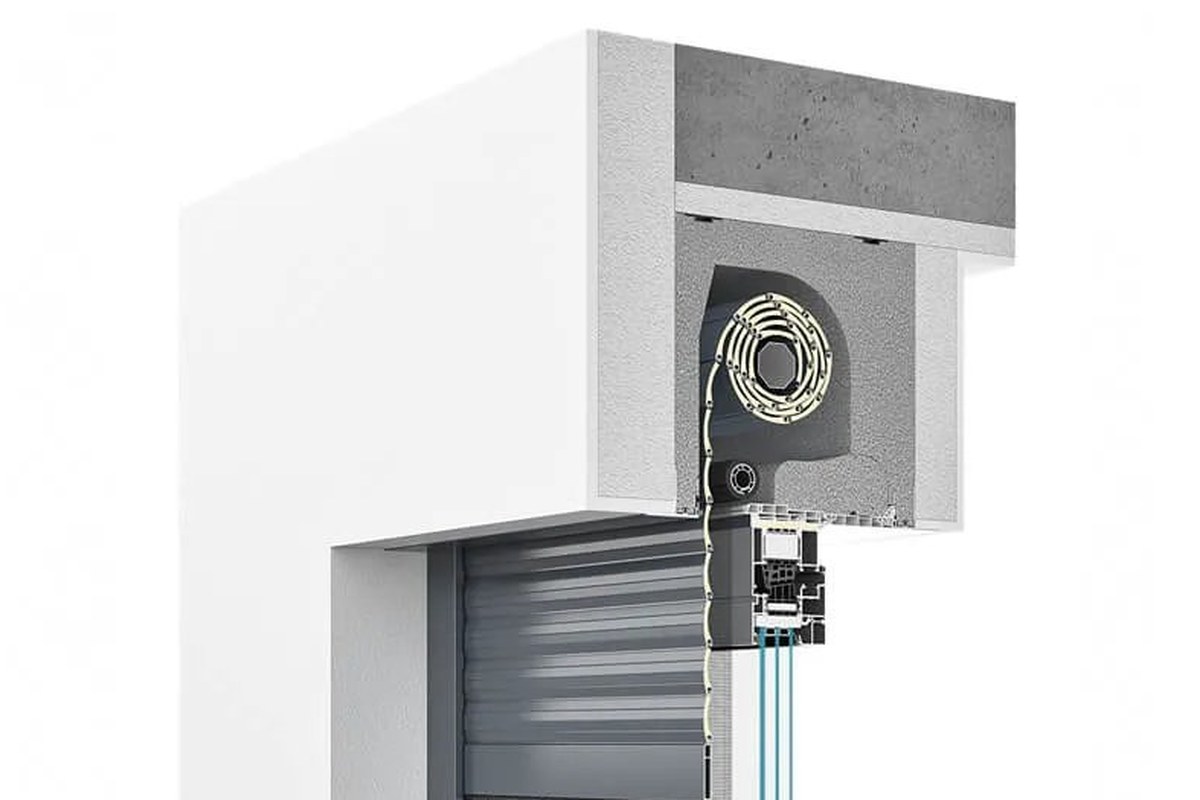
Why the window is the coldest spot in the wall
Heat leaves an insulated wall slowly. Against that background a window is the thin spot: a square metre of glazing lets several times more heat through per hour than a square metre of the wall beside it. That is not a defect — it is the price of daylight and a view.
During the day the sun gives part of it back. At night it does not. In December, Riga has less than seven hours between sunrise and sunset, which leaves more than seventeen hours when the window only gives heat away. Those hours are precisely where an exterior shutter changes something.
The air gap: the reason the curtain comes down
A closed shutter does not insulate the window by the thickness of its aluminium. It creates a closed layer of air between the curtain and the glass. The European standard EN 13125 describes how that layer adds extra thermal resistance ΔR to the window, and classifies external blinds and shutters by air permeability: the closer the curtain sits in its guide rails and the fewer gaps around the perimeter, the larger the gain.
Three consequences follow, and they matter more than any advertised percentage:
- Gaps at the sides eat the effect. The guide rails and how they meet the reveal are not a detail — they are half the result.
- A window left ajar for ventilation behind a closed shutter cancels the air gap completely.
- A shutter nobody remembers to close saves nothing. That is why a “thermal” set-up almost always includes a Somfy or Torro motor and a time or dusk schedule — not for comfort, but so the curtain comes down every evening without anyone thinking about it.
The box: where heat escapes around the clock
The most common mistake when choosing is to look at the curtain and ignore the box. The curtain only works when it is down. The box sits in the opening permanently, and if it is not insulated it becomes a thermal bridge above the window twenty-four hours a day — in summer as well. That is why manufacturers measure a separate figure: Usb, the heat transfer coefficient of the box.
Among the Aluprof systems we work with:
- SKB Styroterm — a built-on box made from a purpose-developed composite, 260×260 or 300×300 mm, set straight into the insulation layer. Usb from 0.29 W/(m²K), confirmed by tests at the IFT Rosenheim institute. That is the best figure among comparable systems.
- SKT Opoterm — a built-on box designed to sit under the insulation. The SKT 230/170 version with an integrated insect screen reaches Usb = 0.73 W/(m²K) (also IFT Rosenheim). A screen inside the box normally worsens the thermal figures; here it does not.
- SK / SKE / SKP and SKO — surface-mounted boxes fixed to a finished façade from outside. They lose to built-on boxes on thermal performance, but they go onto an existing house without rebuilding the reveals or the insulation.
If the house is being built or insulated, the box belongs inside the insulation — only then is the conversation about heat a serious one. If the house has been finished for years and nobody is going to touch the façade, a surface-mounted shutter will still give you the air gap and the blackout, but do not expect a thermal miracle from it.
The concealed SP system and its Passive House certificate
The SP / SP-E system hides the box inside the façade insulation: from outside only the guide rail profile is visible, the box does not protrude and does not break the line of the window. It holds a Passive House Institute certificate (Passivhaus Institut, Darmstadt), No. 0664rs03, for the cool-temperate climate — the one Latvia belongs to.
The certificate states: efficiency class phB, window Uw 0.80 W/(m²K), Uw of the installed window together with the box — 0.85 W/(m²K), thermal bridges at the installation joints Ψ ≤ 0.025 W/(mK). The certificate is valid until 31 December 2026.
Read that literally: the box added five hundredths to the window — provided the installation follows the institute's requirements and the window itself belongs to the matching class (Uw ≤ 0.80 with Ug ≤ 0.70 glazing). Fit the same system to an ordinary window and install it “more or less right”, and the certificate's numbers no longer describe your building.
The curtain: foam-filled, PVC or extruded
- Foam-filled aluminium profile (PA 39–55, PU/PA coating) — the working choice for most windows and balcony doors.
- PVC (PT 37/52) — lighter and cheaper, sensible on small openings; behind aluminium on stiffness and service life.
- Extruded aluminium — for wide openings and for burglar-resistant systems. Here the job is strength, not heat.
More than forty colours, including wood-effect finishes, make no difference to the thermal figures. They do make a difference to whether you will be happy looking at your own façade for the next fifteen years — which is why we pick the colour from a physical sample during the survey, not from a screen.
What a shutter will not do
A shutter will not fix a bad window. If the frame has dried out and the installation joint is leaking air, deal with the window first, not with what hangs outside it.
During the day, with the curtain up, the window performs exactly as it did before — except that the box is now in the opening for good. That is one more argument for an insulated box.
And the main point: treating a shutter purely as “an investment in heating” is the wrong frame. Heat is one of four effects here, alongside complete blackout in the bedroom, less street noise and physical protection of the window. Judged on heating alone the payback is slow; judged on all four, the question closes far sooner.
What to choose in your situation
- The house is finished and you will not touch the façade — surface-mounted SK / SKE / SKP or SKO. Fitted from outside, no rebuilding of reveals.
- You are replacing windows or insulating the façade — built-on SKB Styroterm or SKT Opoterm. This is the moment when the box can disappear into the insulation.
- You are building to an energy-efficient standard — concealed SP / SP-E with the PHI certificate and installation to the institute's requirements.
- You also need security — Safety Plus (RC2) or Safety Premium (RC3) to EN 1627. We cover burglar resistance classes in a separate article.
Frequently asked questions
By how much will a shutter cut my heating bill?
Honestly: the figure is different for every building. It is calculated to EN ISO 10077-1 with the ΔR addition from EN 13125, and it depends on the window, its orientation, the glazed area and on discipline — whether the curtain comes down every evening or every other one. Any “percentage saved” quoted without those inputs is advertising, not arithmetic.
Which matters more, a warm curtain or a warm box?
The box. The curtain only works when it is down; the box is in the opening all the time. The difference between an insulated and an uninsulated box shows all year round.
Can a shutter be fitted to a house that is already finished?
Yes — that is what surface-mounted systems are for: the box is fixed outside above the window and the reveals and insulation are left alone. Built-on and concealed systems require façade work, so they go in together with new windows or new insulation.