
Eight types of blind and curtain: what the market offers
In everyday speech, "blinds" covers almost anything that shades a window and is not a fabric curtain on a pole. In practice the word hides eight quite different constructions, and each solves a different problem. Here is a short summary of each, with figures from the data sheets of the manufacturers we work with.
| Type | Where it is fitted | Maximum in a single fabric width | Without drilling | Price |
|---|---|---|---|---|
| Aluminium venetian | sash, reveal, wall; wet rooms | 410 × 450 cm (Basic 50), up to 23 m² with a motor | yes, 16 mm slat on the sash | from €35/m² |
| Wooden and bamboo | living rooms, studies, bedrooms | up to 320 cm wide (50 mm slat) | no | from €85/m² |
| Roller blinds | sash (Midi), reveal, wall, ceiling | 400 × 440 cm (Absolute L), up to 12 m² | yes, Midi 25/28 on the sash | from 24 €/m² |
| Day–Night (zebra) | sash, reveal, wall | 280 × 300 cm, up to 9 m² with a motor | yes, Midi 25/28 on the sash | from 28 €/m² |
| Cassette roller | sash only — the fabric runs in side channels against the glass | 400 × 420 cm (Absolute L), up to 16 m² | chosen during the measuring visit | from 34 €/m² |
| Pleated blinds | sash, sloping and roof windows, triangles and trapeziums | 150 × 150 or 120 × 220 cm (Vegas PV1); Cosiflor F1 up to 230 × 260 cm | yes, clamp-on shoes and brackets | from €32/m² |
| Vertical fabric | reveal, wall, ceiling; offices, full-height glazing | 700 × 450 cm (Enigma), louvre pack up to 8 kg | no | from €21/m² |
| Roman blinds | wall, ceiling, reveal | 300 × 300 cm (Moderno), 400 × 460 cm (Ultra) | yes, Moderno brackets | from €39/m² |
Prices are per square metre of the finished blind in a base fabric or colour; the exact cost depends on the system, the size and the material, and every product page has a calculator that works it out from the manufacturer’s price list. Installation is quoted after the survey.
Room by room: bedroom, kitchen, living room, nursery
Bedroom. Darkness is the deciding factor. A free-hanging roller blind or a zebra blind always leaves a halo of light along the edges of the fabric: that is a property of the construction, not a fault. If you need complete darkness to sleep, choose cassette roller blinds with a blackout fabric — the fabric runs in side channels, sits against the glass and covers the whole window opening — or a blackout fabric paired with heavy curtains. For those who like waking to daylight, the compromise is a Day-Night with the denser Duolight fabrics, the densest of which are Neroli and Nuit, from 0.40 mm thick.
Kitchen and bathroom. Damp, steam and grease. Here powder-coated aluminium wins outright: aluminium venetian blinds are unaffected by humidity and temperature swings, wipe clean with a damp sponge and do not fade. All five systems — V13, Isotra Hit, Diplomat, Basic and Premium — are suitable for wet rooms. We do not recommend wood in a kitchen even when customers press for it: in a damp zone it behaves worse than aluminium, and we say so plainly.
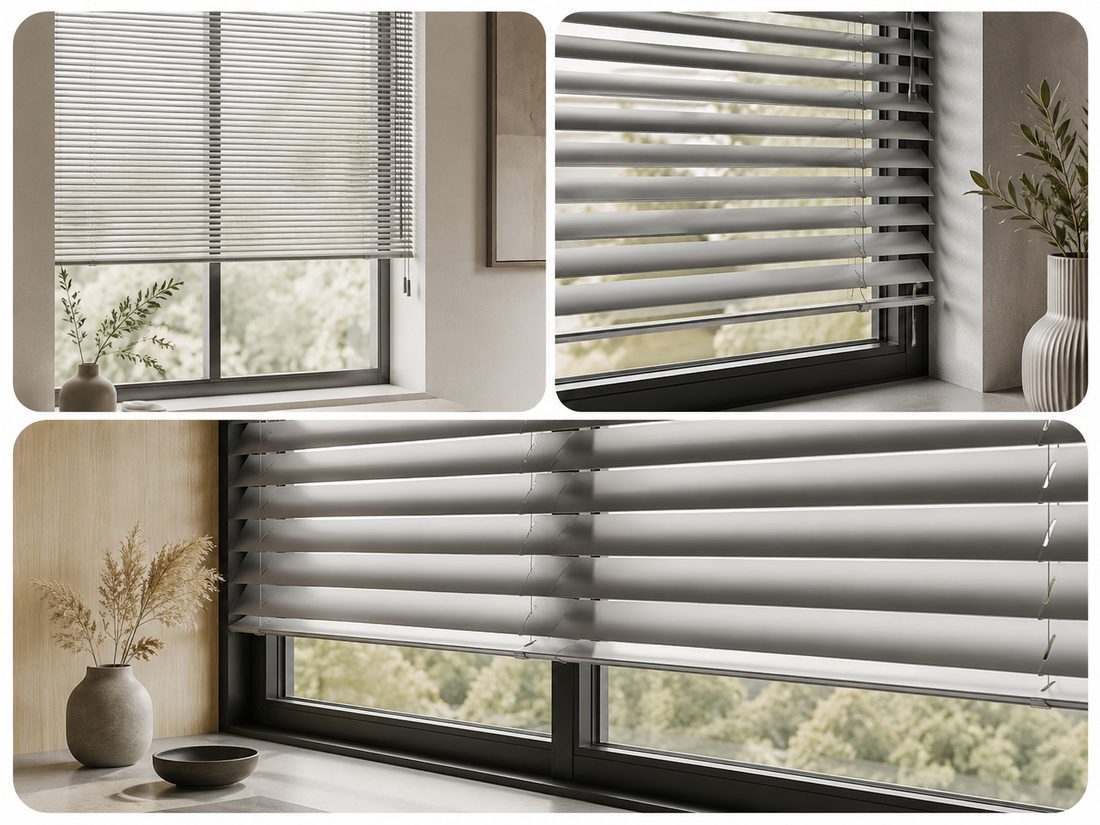
Living room. Here the view and the interior decide. For full-height glazing and picture windows, roller blinds in screen fabric: they hold back heat and glare without cutting off the view. For a classic interior, wooden or bamboo blinds with a 50 mm slat; for loft and minimalist schemes, aluminium in 35 or 50 mm — a wide slat looks stronger on large windows and takes less effort to raise. If you want textile without a pole across the whole wall, consider Roman blinds.
Nursery. Two requirements: safety and resistance to small hands. A hanging chain is a risk to a child, so look at the Basic spring roller system (no chain: pull the bottom bar and the spring holds the height), pleated blinds with a handle bar and no cords, and the Child Safety versions of venetian blinds and Cosiflor pleated blinds. Choose washable fabrics, and fit the blind on the sash so the window can open without catching it.
Loft conversions and non-standard windows. Sloping VELUX, FAKRO and ROTO windows are covered by the 25 mm Dekolux cassette blind (the size is set by the window model code, GGL M06 for example), and also by Vegas PV2 pleated blinds and tensioned Cosiflor VS on wires, which hold the fabric at any angle. Triangles, trapeziums and arches are the territory of Cosiflor pleated blinds, while for tall raked windows there are vertical blinds for trapeziums.
Most often we do it like this: aluminium in the kitchen and bathroom, a cassette blackout in the bedroom, screen fabric or wood in the living room, spring roller blinds or pleated blinds in the nursery. Different systems can still be kept to one colour and one fabric — manufacturers run identical collections for roller, cassette and zebra blinds.
How to read your window: sash, reveal, wall
Before you choose, look at your window rather than at a catalogue. There are three places a blind can go, and that decides the type, the size and the price.
- On the sash. The most popular option for PVC windows: the blind travels with the sash, the window opens and tilts freely, and the sill stays usable. This is where the compact systems go — 16 and 25 mm aluminium, Midi 25/28 roller blinds, Uni 19 cassettes, pleated blinds. The limit is size: a sash is rarely wider than 80–100 cm, and the depth of the glazing bead dictates which headbox will fit.
- Into the reveal. The blind sits inside the window recess, between the jambs. Neat and discreet, but it needs an accurate measurement at three points across the width — reveals are almost never truly rectangular.
- On the wall or ceiling. The fabric overlaps the opening by 10–20 cm on each side, covering the jambs and any light gaps. This is how vertical blinds, Roman blinds, large RT 40/45 and Absolute L roller blinds and wooden blinds on full-height glazing are fitted.
The glazing bead depth and the window handle are a story of their own. If the handle protrudes and the headbox is deep, the fabric will foul it; if the glazing unit is set shallow, the cassette will not fit. A fitter checks all of this during the survey — which is exactly why we do not take sizes over the phone for blinds mounted on the sash.
Light control: sheer, dimout, blackout
Fabrics fall into three classes according to how much light they let through. Sheer and semi-transparent (screen, voiles, light plain fabrics) diffuse the light and remove glare — for living rooms and workspaces. Dimout noticeably darkens the room but not to pitch black — the all-round choice for most windows. Blackout (full room darkening) lets no light through the fabric at all — bedroom, nursery, home cinema; it gives full darkness only in a cassette with side channels or paired with heavy curtains.
With aluminium and wooden blinds the degree of shade is set by tilting the slats rather than by the fabric. They never go fully dark: light passes through the cord holes in the slats. On the Isotra Hit system the holes are offset (Privacy), which darkens noticeably better, and wooden slats can be ordered with fabric ladder tapes that cover the holes.
A fabric has one more property: heat protection. On a south-facing window, screen fabric holds back solar heat and glare while keeping the view out; Cosiflor pleated blinds are available in metallised and honeycomb energy-saving fabrics; aluminium slats deflect the sun as they tilt. None of this replaces good glazing, but in summer it takes a noticeable load off the air conditioning.
Sizes that can actually be made
Every system has maximum sizes set out in its data sheet: they follow from the weight of the fabric, the length of the tube or headrail and the capacity of the mechanism. In an ordinary flat those limits are no obstacle — any system will cover a 120–180 cm window. They matter on balcony doors, picture windows and full-height glazing:
- Roller: Midi 25/28 — up to 170 cm wide and 3 m²; RT 32 — up to 210 cm; Absolute L — up to 400 × 440 cm and 12 m².
- Day–Night: the recommended fabric width is up to 220 cm; on wider fabrics the zebra stripes can close unevenly, so wider openings are split into several fabrics (Multi-Link — 2–3 fabrics on one tube).
- Aluminium 25 mm: V13 — up to 298 × 250 cm and 5 m²; with a 24 V motor — up to 7.5 m²; Basic 50 — up to 410 × 450 cm, and up to 23 m² with a 230 V drive.
- Vertical: Basic — up to 575 cm wide on a single headrail, Enigma — up to 700 × 450 cm with no joints; louvre pack up to 8 kg.
- Roman: Moderno — up to 300 × 300 cm and 5 kg of fabric, Ultra — up to 400 × 460 cm and 20 kg with a 230 V motor.
If the opening is larger, that is no problem: we fit several fabrics on a shared headrail so the slat lines align, or divide the window along the mullions. The calculators on the product pages compare the sizes you enter with the data sheets of every system and show straight away which ones will work.
Operation: chain, spring, motor
Chain — the standard for roller, cassette and zebra blinds, the cheapest and most reliable option; the 1:4 gear ratio on the Moderno Roman system lifts up to 5 kg of fabric effortlessly. Spring (Basic roller, Uni ø25 cassette) — nothing hanging down, safe around children. Venetian blinds offer more choice: handle and chain, wand, crank, or monomagic — one control for both tilting and raising. Electric drive — 24 V DC motors for compact systems and 230 V AC for large fabrics, Somfy and OK for roller blinds, radio-controlled Torro for the Basic 50 and Premium 50 venetians. A motor is not there for show: on high windows, behind furniture, in conservatories and in smart-home routines it is the only convenient option, and on large blinds it also extends the permitted area — on Basic 50, from 10 to 23 m².
What makes up the price and how not to overpay
The price of a blind = the system (mechanism, tube, headbox, brackets) + the material (fabric, slats) + the options (motor, side channels, hardware colour, cassette). We work from exactly the same tables as our sales team, so the calculator on the site shows the same figure a colleague would quote. Where you can save without losing quality:
- Standard fabrics instead of the premium collections: the base groups cover most requirements for colour and density.
- Roman blinds in standard fabrics with the tapes already sewn in: ready in 5 working days and noticeably cheaper than made-to-measure sewing.
- One system for every window in a room rather than a mixture: fewer types of bracket and chain, and simpler maintenance.
- Not paying blackout money where dimout will do: in a living room or kitchen almost nobody needs complete darkness.
Where you should not save: on the survey and the installation. A blind on the sash that is 5 mm out will foul the handle or stop the window tilting, and remaking it costs more than the survey did. Lead times for most systems are 6–15 working days, and the warranty is 2 years (4 years on Vegas pleated blinds with metal cord bushes).
Checklist before you order
- What matters most in this room: darkness, privacy, heat protection or the view out?
- Where does it go — on the sash, into the reveal or on the wall? Does the window open for ventilation, and does the blind need to travel with the sash?
- Is the room damp? If so, aluminium or washable fabrics.
- Are there children — do you need a spring, Child Safety or a motor instead of a chain?
- Does the size of the opening fit within one system’s data sheet, or do we split it into several fabrics?
- Do the fabric or slat colour and the hardware colour work with the frame and the interior — samples are best viewed at your own window in daylight.
- Who carries out the survey and the installation, and what does it cost — agreed before the order, not afterwards.
Once you have answers to these questions, the choice narrows to one or two systems and only the fabric is left to settle. Send us your sizes, or better still book a survey: our fitter will come with samples, check the glazing beads, handles and jambs, and suggest an option for every window.
Frequently asked questions
Which blinds are best for a bedroom?
For complete darkness, cassette roller blinds with a blackout fabric: the fabric runs in side channels against the glass and covers the whole window opening. A free-hanging roller blind or a Day–Night blind always leaves light along the edges. If you want soft light in the morning, choose a Day–Night blind in the denser Duolight fabrics.
What should go in the kitchen and bathroom?
Aluminium venetian blinds: powder-coated aluminium is unaffected by damp and temperature swings, wipes clean easily and does not fade. All the systems suit — V13, Isotra Hit, Diplomat, Basic and Premium. We do not recommend wood in wet rooms.
Which blinds are safe for a nursery?
The Basic spring roller system with no chain, Uni cassette blinds with the ø25 spring, pleated blinds with a handle bar and no cords, and the Child Safety versions of venetian blinds and Cosiflor pleated blinds. A motorised drive also removes anything that hangs down.
Can blinds be fitted to a PVC window without drilling?
Yes. Fitted to the sash without drilling: 16 mm aluminium blinds, Midi 25/28 roller and Day–Night blinds, Vegas pleated blinds on clamp-on shoes and brackets, and Moderno Roman blinds on special brackets. The fitter selects the fixing method during the survey.
How much do blinds for a flat cost?
From €21/m² for vertical blinds, €24/m² for roller blinds, €28/m² for Day–Night, €34/m² for cassette blinds, €35/m² for aluminium venetians and €85/m² for wooden blinds. The exact price is worked out by the calculator on each product page from the manufacturer’s price list; installation is quoted after the survey.