
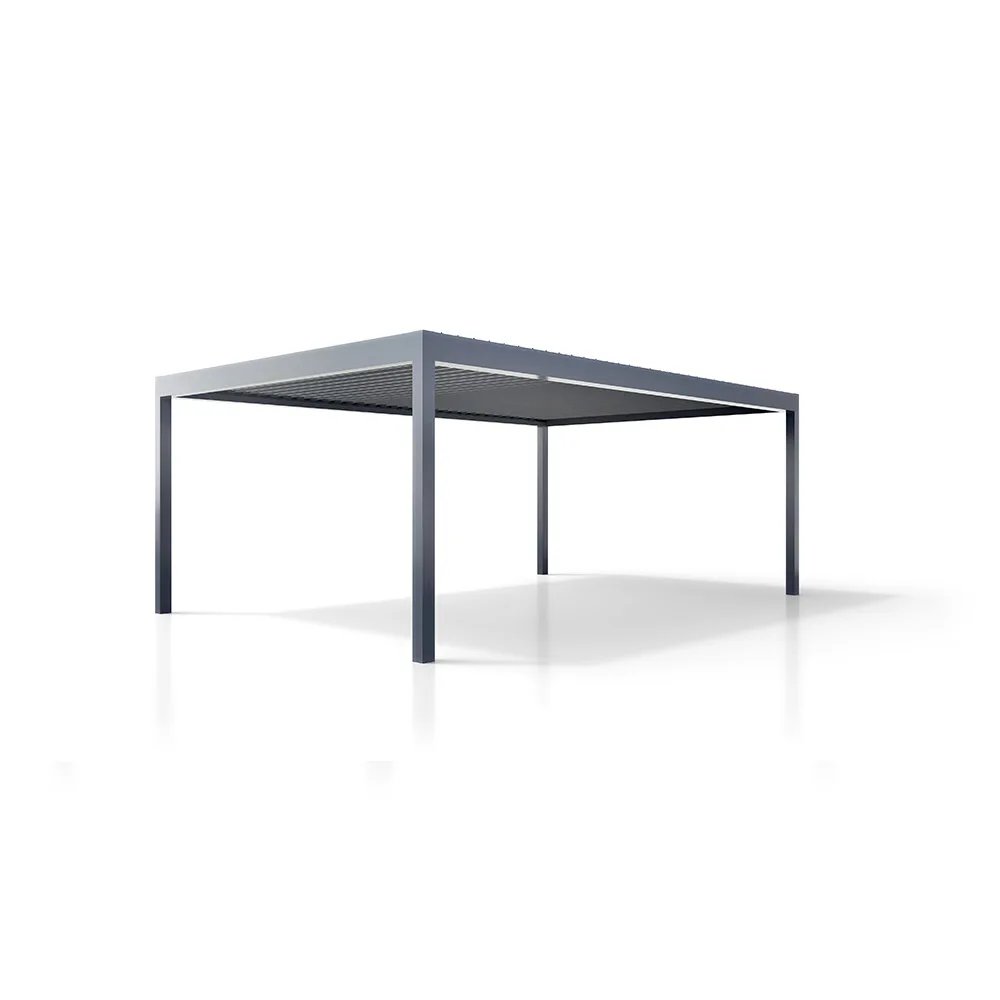
What a bioclimatic pergola is
An ordinary pergola is a lattice of beams with a vine growing over it. A bioclimatic one is an aluminium structure on posts with a roof of adjustable louvres. The louvres rotate through 0–135°: closed, they form a solid roof against rain; part-open, they give shade and through ventilation; turned to the sun, they open the sky. Water runs off the closed louvres into gutters around the perimeter and away through the posts, with no dripping at the edges. That is exactly what "bioclimatic" means: the roof manages the climate beneath it — light, shade and air — rather than simply covering it.
A pergola differs from an awning in principle: an awning hangs on the wall and gives shade through the season, whereas a pergola stands on its own supports, carries snow and wind, can gain glazed walls and lighting, and works all year round.
Louvres or fabric: two kinds of roof
- A louvred roof (SB 350, SB 400, SB 450, SB 550, OpenSky) — aluminium blades on an electric drive that stop at any angle. The advantages: year-round use, snow-load capacity, a watertight seal when closed, and built-in LED lighting. The drawbacks: the price and the weight of the structure — it needs posts and a sound base.
- A sliding fabric roof (Pergola Solid, V ZiiiP) — a waterproof fabric travels along guide rails towards the wall and stacks into a pack. Solid uses PVC-coated polyester, a 5–10° pitch and a beam only 165 mm deep; V ZiiiP uses Serge 1 % fabric (micro-perforated: shade without the greenhouse effect) or Serge 600 (PVC-coated glass fibre for solid rain protection) in zip guides, tensioned like a trampoline so it does not flap in the wind, with a 10–45° pitch. The advantages: lighter and cheaper than a louvred roof, and V ZiiiP needs only two posts. The drawback: the fabric is stacked away for the winter — snow must not be left on it.
Snow and wind: what 72 and 200 kg/m² mean
In Latvia the real question is not whether it will give shade but whether it will survive February. The snow load in the specifications is the mass of snow per square metre of closed roof that the structure carries without deforming. Wet, settled snow weighs 300–400 kg/m³, so 20 cm of it comes to 60–80 kg/m². SB 450 and OpenSky 120 are rated for 72 kg/m² — ample for a normal winter, bearing in mind that the louvres can be opened to shed the snow. SB 550 and OpenSky 140 carry 200 kg/m² — nearly three times as much, which is the fit-and-forget level for exposed sites and commercial terraces. Both are rated for wind up to 110 km/h. Nothing has to be dismantled for the winter.
Fabric pergolas follow a different logic: the roof slides away, so no snow load is specified — the fabric is stacked against the wall for the winter and the frame stays put.
The Aluprof range: from SB 350 to OpenSky 140
| Model | Roof | Dimensions | Snow / wind | Special feature |
|---|---|---|---|---|
| SB 350 | flat louvres, 0–~120°, 150 mm pitch | width fixed at 3.5 m; projection 3.4 / 3.85 / 4.3 / 4.75 m; height 2.5 m | — | a ready-made free-standing unit needing no design work; remote and smartphone control included; anthracite or white MAT |
| SB 400 | louvres to 120°, motor inside the beam | module up to 4 × 7 m, height up to 2.8 m | — | modular: free-standing or wall-mounted, extendable in any direction; LED, zip blinds |
| SB 400R / 400MD | louvres | up to 4 × 7 m | — | 400R — the updated version with the motor inside the beam; 400MD — a roof module without posts, for an existing structure |
| SB 450 | SLIM (Z) or STANDARD (FLAT), 0–135°, with seals | width up to 4 m | 72 kg/m² / 110 km/h | "dry gutter" at 57 l/min, SMART, three types of LED, OpenSlide |
| SB 550 | watertight louvres, 0–135° | width up to 5 m, single- and two-bay | 200 kg/m² / 110 km/h | the flagship: wind, rain and sun sensors; pinned joints |
| OpenSky 120 / 140 | louvres, project systems | 120: up to 6 × 4 × 3 m; 140: a segment up to 7 × 5 × 3 m | 72 / 200 kg/m² | project systems, OpenSlide glazing, SkyRoll screens |
| Solid | sliding PES/PVC fabric | up to 4 × 7 m, height up to 2.5 m, pitch 5–10° | the fabric is stacked away for winter | 165 mm beam, stops at any point |
| V ZiiiP | sliding fabric in zip guides | width up to 5 m, projection up to 6 m, pitch 10–45° | the fabric is stacked away for winter | wall-mounted on two posts, Serge 1 % / Serge 600 |
A single module goes up to 4 m wide (SB 400) or 5 m (SB 550). An 8 × 4 m terrace means two SB 400 modules in a row sharing posts; SB 550 also offers a two-bay layout with no forest of posts down the middle. We work out the layout for your particular site as part of the design.
Walls, light, sensors: how a terrace becomes a room
- LED lighting — linear in the beams, spot lights in the louvres, or a contour line around the perimeter; on SB 400 it is a module option, while SB 450/550 offer three types to choose from. Dimmable from the remote.
- OpenSlide glazed walls and the Slide sliding system — toughened glass in guide rails; the terrace is closed off from the wind and stays usable out of season. OpenSlide is designed for 12 mm toughened glass, and the glass itself is ordered separately.
- Zip blinds and screens — fabric roller blinds in zip guides up to 6.7 m wide: shade from the side, protection from insects and from prying eyes, and SkyRoll integrates with OpenSky.
- Shutters panels — adjustable louvres set vertically, like a venetian blind on the wall.
- Sensors for wind, rain and sun (SB 550, and SMART on SB 450) — the roof closes itself in a downpour and opens up in the heat; control from a smartphone and integration into the smart home.
Sizes and posts: one module or two bays
A free-standing pergola sits on four posts; a wall-mounted one uses two, with the rear edge carried by the façade (or by a wall beam). The posts stand on a concrete base or on cast-in fixings in the terrace — foundations under each bearing point, not under the whole area. Clear height on most models is 2.5–2.8 m. Louvred modules project up to 7 m (SB 400) and span up to 4–5 m, beyond which modules are joined. Fabric roofs run up to 5 m wide and 6–7 m of projection in a single sheet. The drainage arrangement depends on the model: SB 350 has two gutters and four drains discharging through the posts, while SB 450 has a twin-pitch "dry gutter" rated at up to 57 l/min.
What it costs and what goes into the price
The figures below come from the Aluprof catalogue and include 21 % VAT. The price of the structure covers the posts, beams, louvres or fabric, the motor and the receiver with a remote (on SB 350 everything is included, in white or anthracite). Options — LED, sensors, glazed walls, zip blinds — are added separately. The standard Aluprof palette (around 30 colours) is included in the price; a colour outside the palette or a timber finish adds 20 % to the price of the structure and 3–6 weeks to the lead time. Delivery from the factory is €200 per order; if the order can wait for a full load, delivery is free but the lead time is longer. As a guide: a ready-made SB 350 at 3.5 × 3.4 m comes to around €8,100, a wall-mounted V ZiiiP at 2 × 2 m to around €3,500, and an SB 400MD roof module at 1 × 1.4 m for an existing frame to around €2,200; a free-standing SB 400 module at 3 × 3.4 m is around €8,470, SB 450 at 3 × 1.9 m around €8,380, and the flagship SB 550 at 3 × 2.6 m around €11,050 (the second bay costs less than the first). Installation and foundations are quoted after we survey the site. The warranty is 2 years.
How to choose: a checklist
- Do you want a roof all year round, or just shade through the season? All year round means louvres; season and budget mean a fabric roof or an awning.
- An exposed site with no shelter from wind and snow — look at the 200 kg/m² models (SB 550, OpenSky 140); a yard beside the house — 72 kg/m² is plenty (SB 450).
- A site up to 3.5 × 4.75 m and no appetite for design work — SB 350 straight out of the box.
- A long terrace running along the house — modular SB 400 or V ZiiiP in sections.
- You already have a frame or a canopy and need only the roof — the SB 400MD module.
- If glazing and blinds are on the wish list, allow for them from the start: the guide rails and the posts to carry them have to be in the design.
- The base for the posts must be concrete or cast-in fixings; timber decking on its own will not carry a post.
Frequently asked questions
How does a bioclimatic pergola differ from a canopy?
A roof of adjustable aluminium louvres (0–135°): closed, it is a solid roof against rain; part-open, it gives shade and ventilation; fully open, it lets the sun in. Water drains away through the gutters and posts — up to 57 l/min on SB 450. A fixed canopy can do none of that.
Will a pergola survive a Latvian winter?
Yes. SB 450 and OpenSky 120 carry snow up to 72 kg/m², SB 550 and OpenSky 140 up to 200 kg/m², and both are rated for wind up to 110 km/h. Nothing needs dismantling for the winter; on the Solid and V ZiiiP fabric pergolas the fabric is stacked away for the cold months.
What sizes do Aluprof pergolas come in?
Louvred modules go up to 4 m (SB 400) or 5 m (SB 550) wide and up to 7 m of projection, and can be joined to cover larger areas; OpenSky 140 offers segments up to 7 × 5 × 3 m. Fabric roofs run up to 5 m wide with 6–7 m of projection. SB 350 has a fixed width of 3.5 m with projections of 3.4–4.75 m.
How much does a pergola cost?
Working from the Aluprof catalogue with 21 % VAT: a ready-made SB 350 at 3.5 × 3.4 m comes to around €8,100, a wall-mounted V ZiiiP at 2 × 2 m to around €3,500, an SB 400 module at 3 × 3.4 m to around €8,470, SB 450 at 3 × 1.9 m to around €8,380 and SB 550 at 3 × 2.6 m to around €11,050. Delivery is €200 per order (free if you wait for a full load), and installation is quoted after the survey.
Can a pergola be installed on a timber deck?
The posts have to bear on a concrete base or on cast-in fixings — timber decking on its own will not take the load of a roof with snow on it. The survey determines the right solution for your particular site.
What can be added to a pergola?
LED lighting, OpenSlide and Slide sliding glazed walls, Shutters panels, zip blinds up to 6.7 m wide, wind, rain and sun sensors, and control from a smartphone.